A motorized tricycle, motor trike, or motortrycle is a three-wheeled vehicle based on the same technology as a motorcycle, and powered by an electric motor, motorcycle, scooter or car engine.
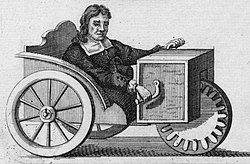
Stephan Farffler
The first recorded trike:
The first recorded trike was built in Germany in 1680 for a paraplegic named Stephan Farffler, using gears and hand cranks. While three-wheeled motorcycles are becoming popular recently, they have a history going back over 200 years. These vehicles have been designed for various purposes, including providing mobility for individuals with disabilities and as transportation vehicles.
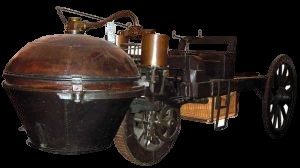
Nicolas-Joseph Cugnot - Steam Trike
The first mechanical trike invented:
The fascination with three-wheeled vehicles is not something new. In fact, the history of the trike begins with the first mechanically powered vehicle a full century before the motorcycle was invented. Nicolas-Joseph Cugnot is recognized for building in 1769 the first self-propelled vehicle intended to transport a person (pictured below). He was also the first to have had a traffic accident. Cugnot built his three-wheeled “fardier a vapeur” with two wheels in the rear and a steam boiler and two-cylinder engine mounted over the front wheel. Designed to carry gun carriages, it had a top speed of two miles per hour and stopped every ten minutes to build up steam.
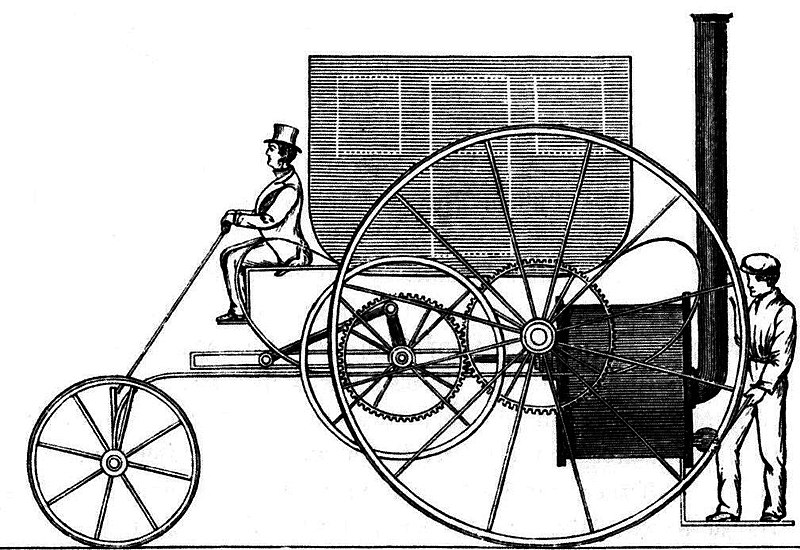
Richard Trevithick - Steam Trike
Cugnot inspired William Murdoch—a former student of James Watt—to build his own three-wheeled steam vehicle in 1784. After seeing Murdoch’s steam vehicle in London, Richard Trevithick subsequently developed his famous steam trike in 1801 (pictured here).
Gustave Trouvé - Electric Trike
The first electric trike by Gustave Trouvé:
Although working as a watchmaker, Gustave Trouvé was known through his workshop established in 1865 in the center of Paris. There, he developed several inventions, finding applications in the field of electricity in particular. In 1881 he improved a small electric motor developed by Siemens with a Starley accumulator. He installed this engine on an English tricycle: he has just invented the first electric vehicle in history.
On April 19, 1881, in the rue de Valois (Paris), the tricycle of Trouvé moved successfully. However, the first ideas are not always those which become mainstream. Gustave Trouvé does not manage to patent his idea, and finally left it aside to dedicate himself to marine propulsion.
The first motorized tricycle invented:
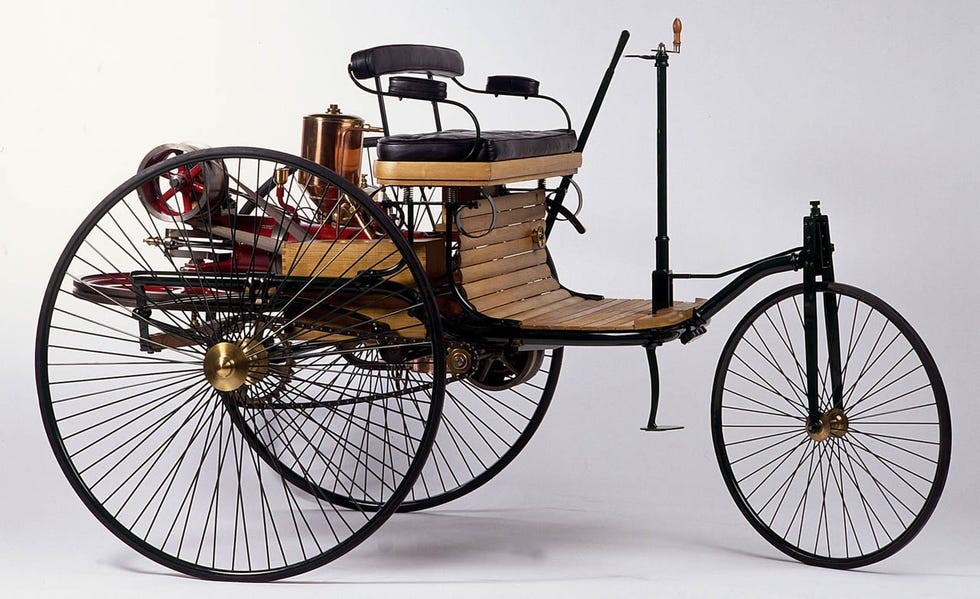
Because when it invented comes to claiming the title of first, no other single individual has a stronger case than Carl Benz, whose three-wheeled, self-propelled, gasoline-powered “Patent-Motorwagen” vehicle first rolled under its own power in 1885.
Carl Benz - Motorized Trike
De Dion-Bouton - Trike
1897 De Dion-Bouton Tricycle:
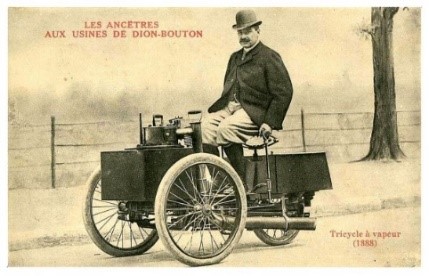
De Dion-Bouton was a French automobile, railcar, and tricycle manufacturer. The company was in operation from 1883 to 1932, and was founded by Marquis Jules-Albert de Dion, and Georges Bouton, based in Passage de Leon, Paris, and began manufacturing steam engine cars in 1883.
During that era, De Dion-Bouton was the world’s largest automobile manufacturer. Their vehicles were known for their high quality, durability, and reliability. In 1896, the company produced their first tricycle. They continued producing tricycles for several years, but their main business was always automobiles. World War I caused the company to struggle financially, and the Great Depression brought on more of a decline in sales. The De Dion-Bouton company produced their last automobile in 1932.
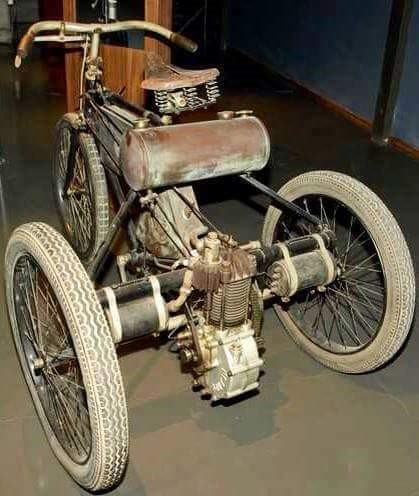
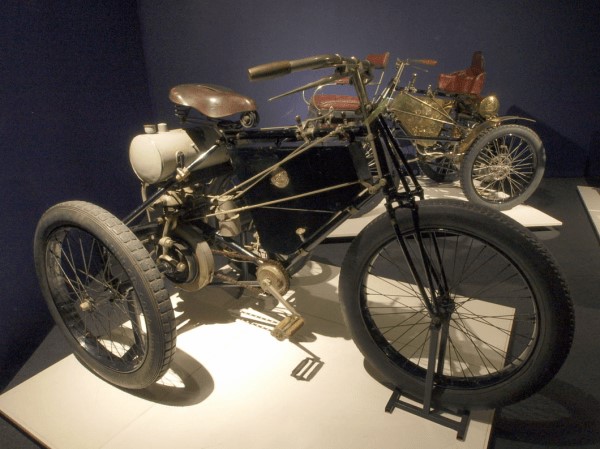
Both the world’s oldest running automobile and the oldest running motorcycle in North America are made by De Dion-Bouton. The world’s oldest running automobile is an 1884 De Dion-Bouton Et Trapardoux Dos-a-Dos Steam Runabout, which sold for $4.62 million in October 2011. The oldest running motorcycle in North America is an 1897 De-Dion Bouton tricycle, and we are proud to have it on permanent display at Motorcyclepedia in our Circa gallery.
De Dion-Bouton - Mechanical Trike
1897 De Dion-Bouton Motor Trike – World’s First Sexy Ad And First High Speed Engine
There’s a few other pioneering firsts that go along with the De Dion-Bouton motor trike, one of the most important early internal combustion vehicles. But this wonderful ad, one of the oldest in the industry, tells quite a story. As the bicycle had largely replaced the horse as personal transportation, so the De Dion-Bouton now threatened to upset its dominance. And as with any new disruptive high-tech device, the early adopters were shown to be young, sexy, and irreverent. The world of personal transport was never going to be the same, and the 1897 De Dion-Bouton led the charge into the new century.
Jules-Albert de Dion, the engineer Georges Bouton and his brother-in-law, Charles-Armand Trépardoux, founded the firm De Dion-Bouton near Paris in 1882. They started with steam boilers, but soon caught the self-propelled bug, and started building steam-powered vehicles. In 1884, the built this steam trike, which was remarkably successful technically, as well as quick. It won the world’s first race for self-propelled vehicles, with an average speed of 16 mph, and allegedly hitting a top speed of 37 mph. It was on the larger four-wheel De Dion-Bouton steamers that the eponymous rear axle design was first used, with a solid beam axle carrying the load, but power transmitted to the wheels independently.
Jules-Albert de Dion
De-Dion-Bouton steam trikes soon became the hot new thing for rich playboys, which probably helps explain the ad for the later motor trike. During this era, De Dion-Bouton was the world’s largest manufacturer of self-propelled vehicles.
Having seen Gottlieb Daimler’s gasoline engine at the Paris Exposition in 1889, De Dion and Bouton decided that was the future. They decided to build a small engine, one that could be used to power a bicycle. As it turned out, they felt that the engine was too heavy for two wheels and went with a tricycle configuration, which means that technically, it’s not the world’s first motorcycle; that honor goes to the 1894 Hildebrand & Wolfmüller. But in reality, the De Dion-Bouton was vastly more advanced and successful, as it had the world’s first high-speed internal combustion engine. It legitimately is the first successful motorized bike/trike.
Gottlieb Daimler’s gasoline engine
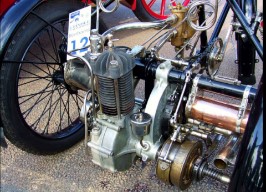
The initial single cylinder engine had only 133cc, but because it was able to run at the then-unheard of speed of 1500-1800 rpm (the 1894 Hildebrand & Wolfmüller managed all of 240 rpm, and the Daimler “Reitwagen”750 rpm), its power output was a very respectable 0.5 hp. Later version were larger and considerably faster; by 1904, it had 995 cc and 8hp. A De Dion-Bouton trike set a land speed record on April 13, 1902 of 109 kmh (68 mph), with French racer Georges Osmont leaning over the handlebars.
What was the breakthrough that allowed higher engine speeds? Up to that time, ignition was by either a glow plug or gasoline-fired “hot tube”. The De Dion-Bouton had a dry-cell battery-operated high-voltage ignition system, firing a spark plug. With ignition timing now controlled, the engine was able to run much smoother and faster. The battery cells are carried in the box below the top central frame tube. But like most engines of the time, there was no carburetor at all; just a tank in which gasoline vaporized naturally, and that vapor was then fed to the engine. Drive was direct (no clutch), but there was a differential.
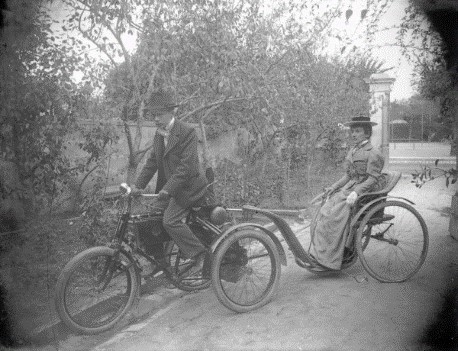
The De Dion-Bouton motor trike was a very influential vehicle, due to its technical superiority and light weight. Although it was hardly cheap, it offered better performance than many of the heavy and very expensive early motor cars. With a trailer in tow, it was capable of hauling one’s sweetheart (or mother?), in a more realistic setting than the one from the ad. By 1900, it was the most popular motorized vehicle in France, which then by far was the world’s leader in motorized transport.
In addition to being built for ten years in France, numerous companies in most major countries were licensed to build the de Dion-Bouton motor trike, with some changes. Two companies, Thomas and Orient, built versions in the US. And the De Dion-Bouton inspired the many motorcycle makers that soon sprang up everywhere, as the means of making small engines operate more powerfully was the breakthrough, especially when actual carburetors were added within a few years.
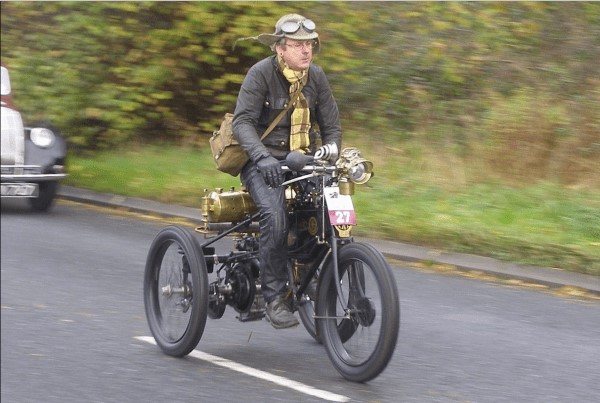
These rugged trikes are still to be seen in vintage events, like this one in the 2008 London to Brighton run. The de Dion-Bouton was the most effective and cheapest way to experience the high of high speed in its time. It didn’t get much sexier than that, on wheels.